
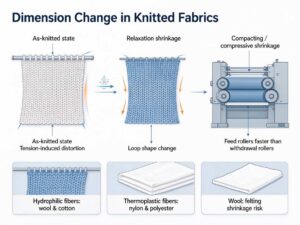
Changes in dimensions after knitting can cause significant problems in garments and fabrics, particularly those made from hydrophilic fibers such as wool and cotton. Articles knitted from synthetic thermoplastic fibers like nylon and polyester, however, can be heat-set to a shape or size that remains stable, provided the original setting conditions are not exceeded during washing and wear.
In wool fibers, dimensional change can be made worse by felting shrinkage. When untreated wool is exposed to mechanical action in a moist environment, the fiber’s elasticity and unidirectional scale structure cause the fibers to migrate and interlock into an increasingly dense entanglement. Long before the felted fabric reaches its maximum density, the fabric’s properties and appearance are already seriously damaged. Fortunately, shrink- and felting-resistant finishes can now be applied to wool yarn during spinning, so that, similar to cotton yarn, relatively little shrinkage occurs during washing and wear.
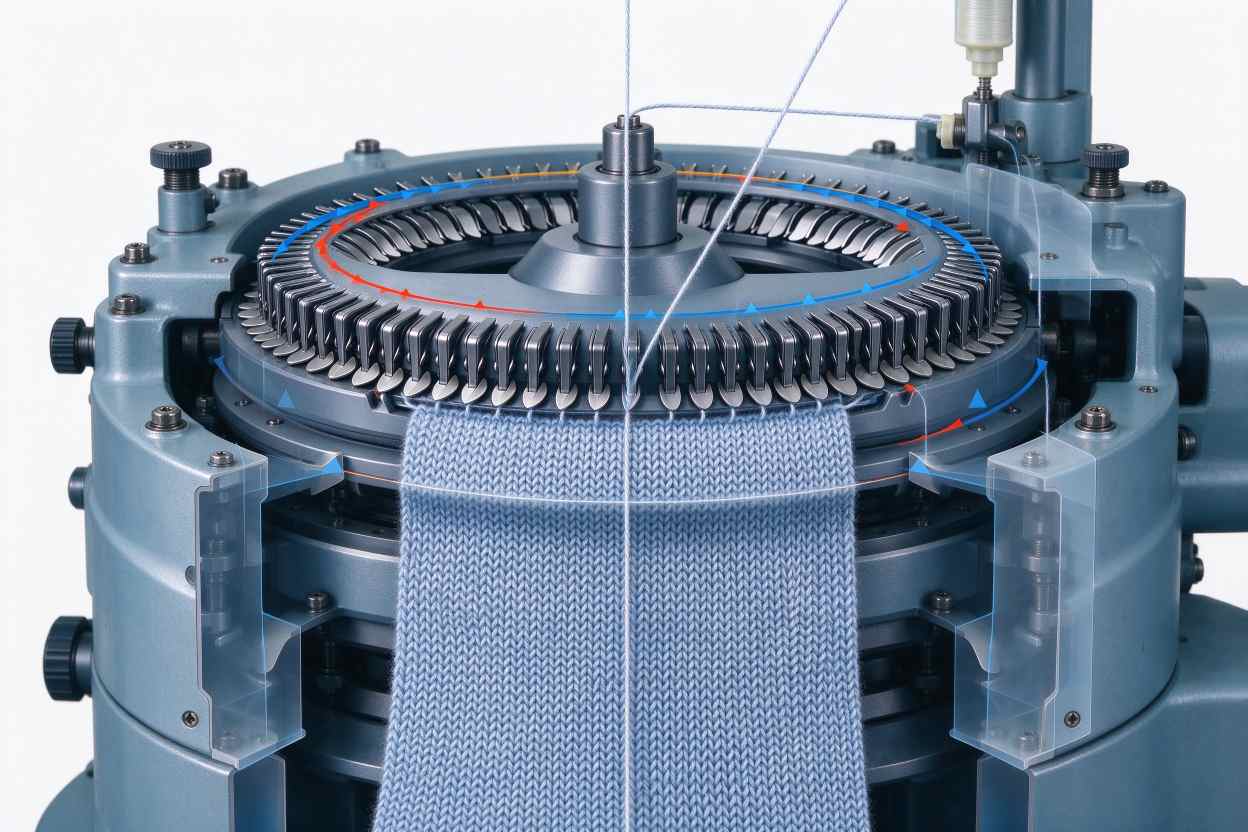
Even without yarn shrinkage, knitted fabrics often change in width and length after being removed from the machine. This indicates a change in loop shape rather than loop length. During knitting, the loop structure is subjected to tension of about 15–25 grams per needle, mainly from the take-down mechanism and, in fabric machines, from the width stretcher board. If the structure is not allowed to relax from this strained and distorted state during manufacturing, the more favorable relaxation conditions encountered in washing and wear will produce unexpected dimensional change and customer dissatisfaction.
An effective relaxation technique used in the continuous finishing of cotton fabrics is compacting or compressive shrinkage. The fabric passes between two sets of roller nips, with the feed rollers running faster than the withdrawal rollers. This pushes the courses closer together and encourages the fabric to shrink positively in length. This method can be problematic for interlock fabrics, which tend to buckle three-dimensionally, creating surface ripples known technically as “orange peel”.