

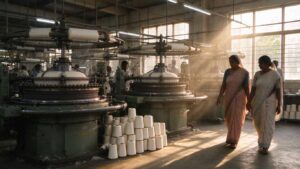
MUMBAI, INDIA — July 1, 2017 — India’s imports of circular knitting machines surged in 2016, reflecting a broader shift in global textile machinery investment toward Asia, according to data compiled by the Indian Textile Journal. Approximately 87% of all new circular knitting machines shipped worldwide in 2016 were delivered to Asian destinations, with India emerging as one of the fastest-growing single-country markets.
The figures come from the International Textile Manufacturers Federation (ITMF) shipment statistics, which track deliveries of large circular knitting machines across single jersey, double jersey, and jacquard categories. The data showed that while shipments of short-staple spinning spindles declined by 12% year-on-year in 2016, deliveries of new long-staple spindles and open-end rotors soared by nearly 111% and 66% respectively — a sign that Indian textile mills were prioritizing upstream fiber preparation to feed their expanding knitting capacity.
Indian knitwear clusters in Tirupur, Ludhiana, and Mumbai have been investing heavily in circular knitting capacity over the past two years, driven by growing demand from both domestic apparel brands and export buyers. The influx of imported machines — predominantly from China, Taiwan, and a small but growing share from Germany and Italy — has allowed Indian mills to upgrade from older mechanical circular knitting units to more efficient electronic models.
Industry consultants said that the quality gap between locally built and imported circular knitting machines has narrowed, but premium European and Japanese machines still command a price premium for jacquard and high-speed applications. Chinese manufacturers, meanwhile, have been steadily improving quality and now dominate the mid-range segment, offering machines at price points 30–40% lower than their European counterparts.
Looking ahead, analysts predicted that Indian circular knitting machine imports would continue to grow as the country’s apparel sector expands and brands seek more flexible domestic sourcing. The government’s Make in India initiative, while primarily focused on apparel manufacturing, has indirectly benefited machinery suppliers by encouraging mill modernization and capacity expansion.